Ohmsville
simulation
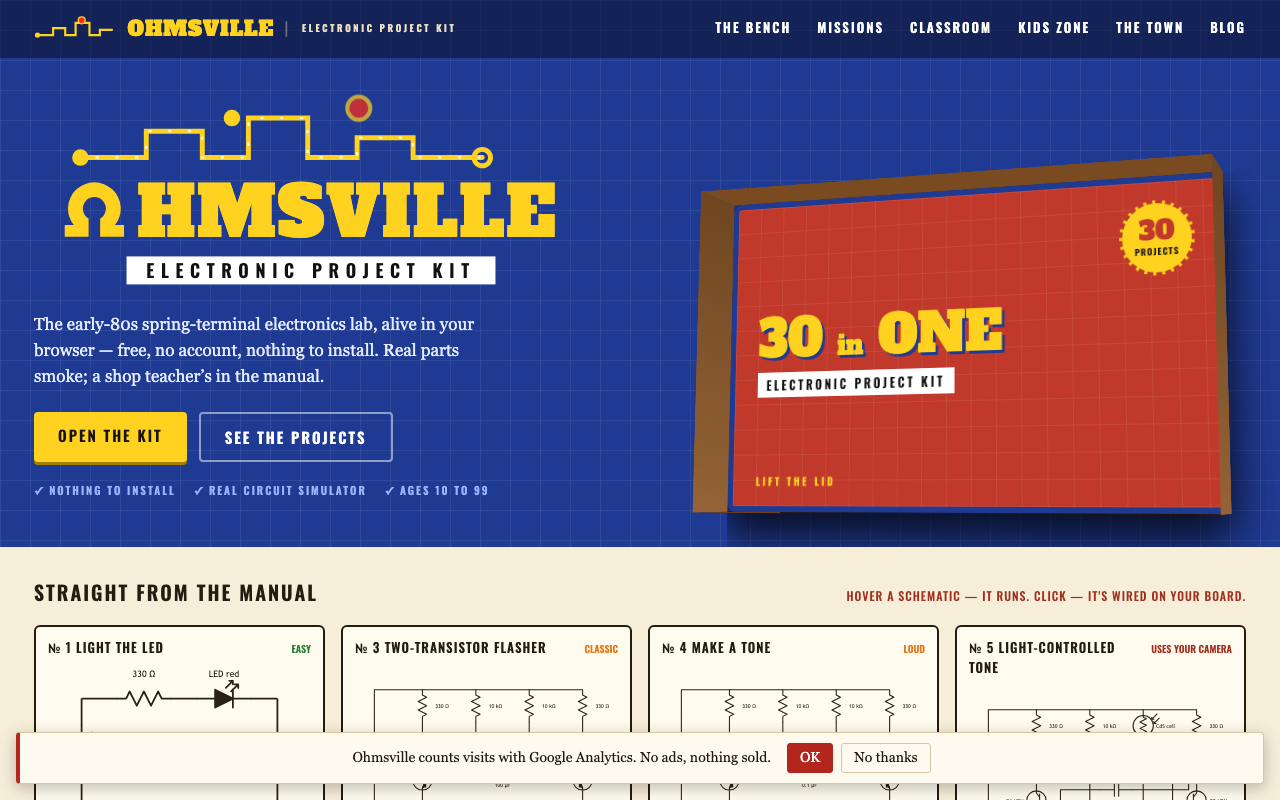
Ohmsville is a browser recreation of the electronics kit a lot of us actually had as a kid — the Radio Shack-style "N-in-1" box with a spring-terminal board, real parts, and a fold-out manual telling you what to wire next. Here the board runs a real circuit simulator underneath, so an LED you wire correctly actually glows, a speaker you wire correctly actually plays a tone, and a mistake actually smokes. Nothing about the physics is faked for effect: wrong wiring behaves like wrong wiring, on purpose.
The board sits in a small town, Ohmsville, that the same kit is remembered from — a single strip-mall street with an electronics shop, an arcade, and a video store, the same buildings across every decade from the 1970s to the early 2000s, with only what's in the windows changing. A shop teacher sits in the manual and explains what your circuit is doing, answers "why did it smoke," and nudges you toward the current experiment's goal without ever handing you the finished answer.
Rules
You wire the board by dragging between spring terminals, the same way the original kit worked: pick a part off the manual page, drag a wire from one spring to another, and the board rebuilds the live circuit every time a wire or a knob changes. Real parts are on the board — battery, resistor, potentiometer, capacitor, LED, transistor, switch, speaker, and a photocell the webcam can drive — and each one behaves the way its real counterpart does: an LED lights in proportion to the current through it, a speaker plays whatever voltage swing reaches it, and a part exceeding its rating burns and blackens rather than just failing silently.
The manual walks you through a sequence of experiments — light an LED, dim it with a potentiometer, make it blink, make a tone, then make the tone respond to light — each with a goal and the original kit's own wiring-list style ("spring 3 to spring 17"). Free play is always available alongside the experiments: any wiring you want to try is legal, and burning a part is treated as something you learn from, not a failure state — parts reset unburnt when you reset the board.
Story campaigns lay a mission over a run of experiments already on the board: each chapter is one experiment, given a reason to build it and a short beat of real electronics history once you pass it, ending in a payoff scene driven by your own finished circuit. Later levels add more of the original kit's part list — diodes, buzzers, relays — building toward the kind of logic the first computers were built from, one bench build at a time.
Screenshots